
J. Jabbour
Historical Introduction: The Catastrophic Void After Assad’s Fall and the Rise of Extremism
In a historic event that shook the region and the world, Bashar al-Assad’s regime collapsed in December 2024, following decades of tyranny that plunged the country into the abyss of a devastating war. The fall of this regime marked a pivotal moment, yet unfortunately, it did not lead to the anticipated peace. Instead, it vacated the arena for extremist ideological forces. Hay’at Tahrir al-Sham (HTS) seized control of most Syrian territories, including Damascus, in a dramatic shift that cast dark shadows over the country’s future.
It was not long before HTS began to impose its rigid ideology, committing horrific massacres against minorities, particularly Alawites and Druze, a stark reminder of historical sectarian conflicts that thinkers had long warned against. Meanwhile, the Syrian Democratic Forces (SDF) withdrew to Kurdish-majority areas, leaving a wide expanse for HTS dominance, thus compounding the challenges facing Syria’s social and national fabric. These dangerous developments have placed Syria at an existential crossroads, threatening the disintegration of its unifying identity.
The Birth of the “Syrian National Bloc”: A Civil Project in Times of Crisis
Amidst these turbulent transformations, in September 2025 – nine months after the previous regime’s fall and a few months into HTS’s control – the establishment of the “Syrian National Bloc” (SNB) was announced. This declaration emerged as a beacon of hope in the heart of the catastrophe. The Bloc was formed as a peaceful, civil political movement, aiming to transcend military and extremist ideological factions, and to build a democratic, pluralistic citizen state.
The SNB was founded on the initiative of independent opposition figures with significant intellectual and political weight and a history of civil struggle, led by Dr. Haitham Manaa. The Bloc adopted firm principles consistent with modern state-building, including “decentralization” in state administration, “rejection of extremism” in all its forms, and upholding the timeless slogan “Religion is for God, and the Homeland is for All.” This vision reflects a deep awareness of the necessity to learn from historical mistakes of sectarian polarization and exclusion.
Objectives and Principles: Towards Restoring National Dignity
The core objectives of the Syrian National Bloc are focused on:
Building a citizen state, civil and democratic: Where all individuals are equal before the law, and citizenship is the sole basis for rights and duties, devoid of any sub-affiliation.
Adopting a system of “decentralization” in state administration: As a structural solution that enhances local participation, ensures equitable distribution, and responds to the diverse needs of communities across Syria.
Rejecting sectarian or ethnic approaches in political solutions: Emphasizing that any future solution must stem from a unifying Syrian national identity.
Restoring civil and partisan space: Away from the dominance of military forces and militias, to enable political pluralism and freedom of expression.
An Interview with Mr. Louay Salman: A Testimony from the Heart of the Tragedy
In an exclusive interview for our magazine with Mr. Louay Salman, a founding member of the Syrian National Bloc currently residing in the United States, we delved into a profound analysis of the evolving situation in Syria under HTS control.
Mr. Salman points out that “any organized and logical political movement or demand, whose proponents have a legitimate right to play a role and have an impact, cannot be ignored by the international community.” He further explains the disparity between popular expectations and international political reality: “Syrians generally assume that if we demonstrate today and tomorrow, something must change immediately, but in international affairs, this doesn’t happen so quickly.”
In discussing the currently active forces, Mr. Salman asserts: “Those who brought these current factions and handed them power in Syria did so for a specific purpose and for a limited time.” He believes that “repeated, peaceful, and national (non-sectarian) protests against this authority can exert pressure, influence, and slightly accelerate the end of this rule.” He stresses the necessity for Syrians of all backgrounds to unite and declare to the world “that this authority does not represent us.” He adds, with regret: “The Syrian people must tell the world that we did not reject Assad’s repressive regime only to accept such a takfiri, exclusionary authority.”
Civil Resistance in Damascus: Cries for Freedom in the Face of New Repression
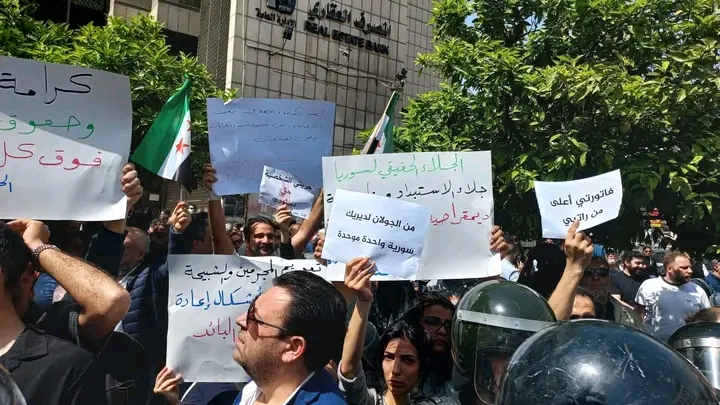
Mr. Salman touched upon the recent Damascus protests against HTS authority, noting it was “a truly brave and heroic act for people to come out demanding their rights.” What was striking about these demonstrations, he clarifies, was the participation of veiled Muslim women alongside secular women, and the diversity of Syrian society’s segments involved, even if in small numbers. This reflects a social cohesion that extremist forces have not been able to completely dismantle.
Mr. Salman then describes the bitter reality under these authorities: “This authority seeks to privatize the entire public sector, including hospitals,” which has led to a systematic deterioration of services. He cites examples of this decline: “Scabies and infectious diseases have spread remarkably, even in schools, and diseases have spread among livestock.” He emphasizes “deliberate neglect of all services that existed in previous eras since independence.” Furthermore, “exorbitant taxes on electricity” have been imposed, with power cut off for those who cannot pay, in a country exhausted by fifteen years of war, where most of its people are poor and unemployed.
Systematic Discord and Human Rights Violations:
Mr. Salman indicates that this authority “antagonizes the rights of all Syrian people,” recalling “the massacres committed by its elements against all minorities,” which have sown “terrible discord among the components of the Syrian people.” The Syrian National Bloc, adhering to the approach of Syria’s founding fathers, unequivocally rejects “all these barbaric practices.”
Mr. Salman reveals recent incidents demonstrating the brutality of these authorities, recounting the HTS raid on the village of Baabda in Jableh two days prior. Under the pretext of arresting a former officer, they “terrorized people and killed a civilian in the village,” with residents habitually fleeing to hide in the groves, while “many homes were looted.” These practices are not fundamentally different from the methods of previous autocratic regimes.
Propaganda and Playing the Sectarian Card:
To cover up these practices, ready-made pretexts are peddled, such as “remnants of the Assad regime are present in the village.” More dangerously, there is “intensified authoritative propaganda claiming there are Hezbollah and Iran remnants in Alawite villages,” where “every Syrian worker forced to leave Lebanon due to the recent war there and return to Syria is branded an agent for Iran.” This disinformation seeks to fuel sectarian animosity and justify repression.
Mr. Salman provides a glaring example of this deception: the arrest of a group of young men from Al-Khandaq village in the Ghāb plain who were returning from Lebanon. One individual’s name and photo appeared twice in arrest reports, “but the irony was the difference in the person’s height between the two reports,” as noted by several news websites, including the “Takkad” platform, which is aligned with the authority’s audience, raising serious questions about the systematic deception and fabrication methods employed.
Geopolitical Stakes and Demographic Change:
He does not overlook the role of regional powers, stating that “the current Turkish authorities are erecting a human barrier and creating demographic change that prevents connection between the Iskenderun region and the Alawite areas on the Latakia coast.” He describes this act as “chauvinistic and hateful” by an authority with a “radical Islamist background.” These policies serve regional nationalist agendas at the expense of Syria’s geographical and demographic unity.
He warns against the perils of Turkish ambitions, saying: “Turkey currently governs Syria through its factions, but Syria is a large bite that Erdogan’s authority will not be able to swallow.” He asserts that “Syria is a poor, plundered country, and the Turkish economy is absolutely unable to help Syria. This alone will, over time, lead to widespread protests in Syria.” He concludes this aspect with the grim picture facing Syria today: “Syria, threatened by famine, with the majority of its people unemployed.”
Conclusion: Faith in Syrian Resilience and the Future of Citizenship:
Despite all these immense challenges, the vision of the Syrian National Bloc remains firmly rooted in the belief in the Syrian people’s capacity to endure and reclaim their historical role in building a civilized state. “The Syria that the National Bloc believes in is a creative Syria that will never, no matter how long it takes, submit to backwardness or degradation.” The ultimate goal pursued by the Bloc is to establish the principle of “Syria for all Syrians,” as a fundamental pillar for a prosperous and stable state founded on justice, equality, and pluralism. What Syria is enduring today is not merely a political conflict, but a civilizational crossroads that will determine the fate of future generations. Herein lies the importance of the role the Syrian National Bloc can play in steering this destiny towards safety, away from tyranny and fanaticism, towards a state that protects all its citizens and ensures their dignity.


