

Rachel Ghannoum
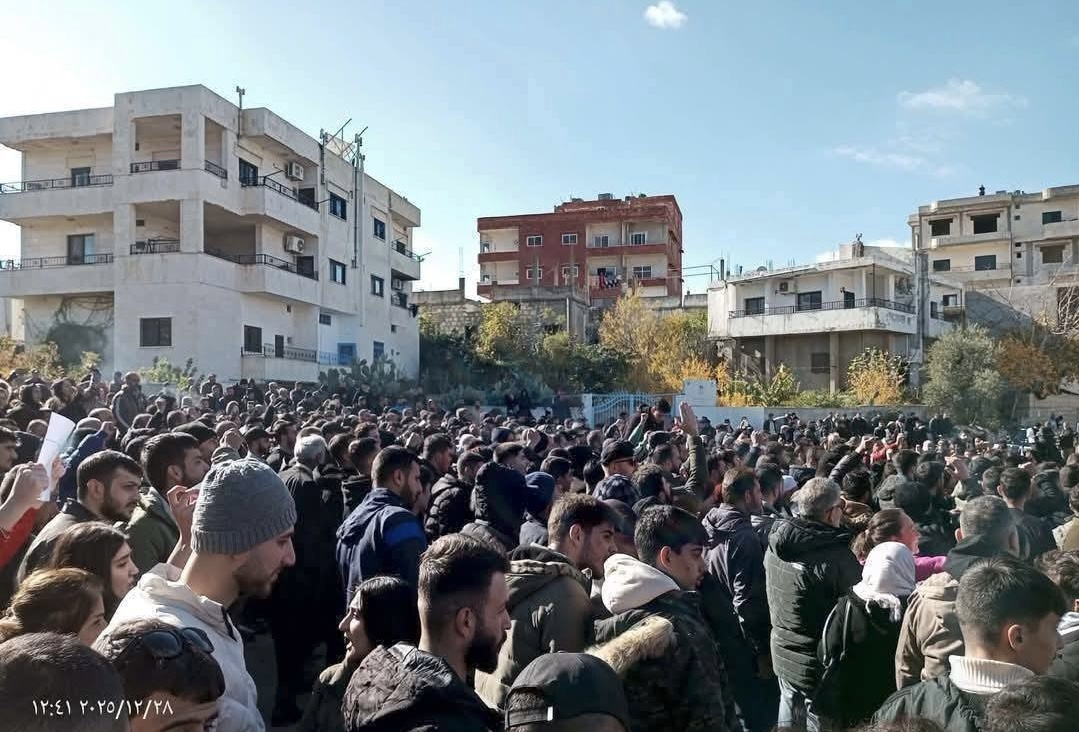
In Latakia—the heart of Syria’s coastline and long regarded throughout the civil war years as a symbol of relative calm and coexistence—signs of a transformation are beginning to emerge, one that could reshape both the city’s character and its future. In recent weeks, large-scale popular protests have erupted across different parts of the city, opening a new chapter in the wave of demonstrations sweeping the country. Under the weight of a deepening political and economic crisis, Latakia is witnessing unprecedented mobilization. Despite the regime’s efforts to impose a tight security cordon around these movements, public anger appears to have surpassed all limits.
The Spark: The Homs Attack and the Traces of Anger
Everything began with an explosion targeting a mosque in the city of Homs, killing a large number of civilians. This attack became the spark that ignited public outrage across Syria, including in Latakia. Calls to take to the streets multiplied in protest against growing security breaches and repressive practices targeting civilians. Among the most prominent of these appeals was that of Sheikh Ghazal Ghazal, who called on residents of Latakia and other coastal cities to gather in public squares to reject injustice.
Latakia Erupts: Unprecedented Demonstrations and Mobilization
Historically known for its strong social cohesion and the firm grip of security forces over public spaces, the city quickly descended into moments of tension and paralysis as protests spread. At the Saadi Junction in Tartus, security forces used tear gas against demonstrators, who in turn chanted slogans demanding justice, accountability, and the adoption of federalism as a solution to Syria’s protracted crisis.
In Latakia itself, the situation was even more severe. At the al-Azhari Junction, security forces attacked protesters, while the deployment of special units and tanks in the streets was used to intimidate the crowds. Protesters, however, remained resolute in their demands—raising growing concerns about the trajectory and potential consequences of the movement.
Violence and Escalation: Live Fire Against Protesters
In a dangerous escalation, demonstrators engaged in peaceful marches to demand their rights were fired upon in the village of Beit Yashout in the rural area of Jableh, leaving many injured. This surge in violence was widely interpreted as a message from authorities in Damascus that control would be enforced through force. It also suggested that protests along Syria’s coast may not be merely fleeting events. Officials appear prepared to resort to the harshest methods of repression to prevent any shift in realities on the ground.
The Alawite Supreme Islamic Council: A Language of Warning
Amid the escalating tension, the Alawite Supreme Islamic Council issued a statement urging citizens to return to their homes while affirming its commitment to legitimate rights. The statement served as a cautionary message aimed at protecting civilian lives at a critical moment. Its message was clear: social peace is a priority—but not at the expense of abandoning rights or remaining silent in the face of repressive practices imposed on civilians.
Latakia at a Crossroads: Heavy Consequences on the Horizon
Today, the situation in Latakia is widely seen as a real test—not only for the Syrian regime, but also for the international community. Long regarded as a strategic stronghold for the regime, the city may now be entering a new phase of protest that could open the door to broader transformations.
As violence and repression intensify, the protests in Latakia lay bare the accumulated anger simmering across Syrian society. Each passing day brings more pressure and heavier burdens on citizens, paving the way for further popular eruptions. Unless the people’s demands—structural change to the system and genuine solutions to the crisis—are met, Latakia and other cities may remain trapped on a burning plate.
Conclusion: Transformations on the Horizon
What is unfolding in Latakia is not a temporary outburst of protest; it may mark the beginning of profound political and social transformations Syria could face in the coming period. The regime now confronts a serious challenge to its security dominance over the coastal cities: on the one hand, efforts to suppress a growing protest movement; on the other, mounting internal and external pressure for fundamental change.
The regime faces a stark choice—either to pursue a more balanced response grounded in national reconciliation, or to plunge the country into a new cycle of violence and escalation that could lead to even greater fragmentation and destruction.


