Jack Jabbour
March 2026
December 8, 2024, remains a date etched into the Syrian memory—not merely as the end of an era, but as the dawn of a grueling new chapter of suffering, particularly for the Alawite community. A full year has passed since the fall of the regime, bringing with it unceasing waves of pain. The massacres committed against the Alawite people, especially in March 2025, were but the opening act of profound demographic and social shifts looming on the horizon.
Demographic Change: “We Shall Return One Day… But to Which Neighborhood?”
“We shall return one day to our neighborhood, and drown in the warmth of our dreams.” These iconic words by Fairuz, once sung with nostalgia and hope across the Levant, have become a hollow echo of a bitter reality. The longing for home now crashes against walls of fear and systematic demographic engineering, aimed at emptying regions of their original inhabitants through intimidation and forced impoverishment.
In the city of Homs, which has endured years of war, these transformations are stark. An Alawite real estate broker in Homs shares a chilling testimony: “I overheard two Sunni lawyers speaking in whispers; they were saying that Alawites are selling their homes for crumbs, and that such-and-such street will soon be entirely Sunni.” This is no mere rumor; it is a tangible reality. Numerous Alawite families in the working-class neighborhoods of Homs are forced to sell their properties at prices far below their value, driven by a singular, desperate motive: the search for safety.
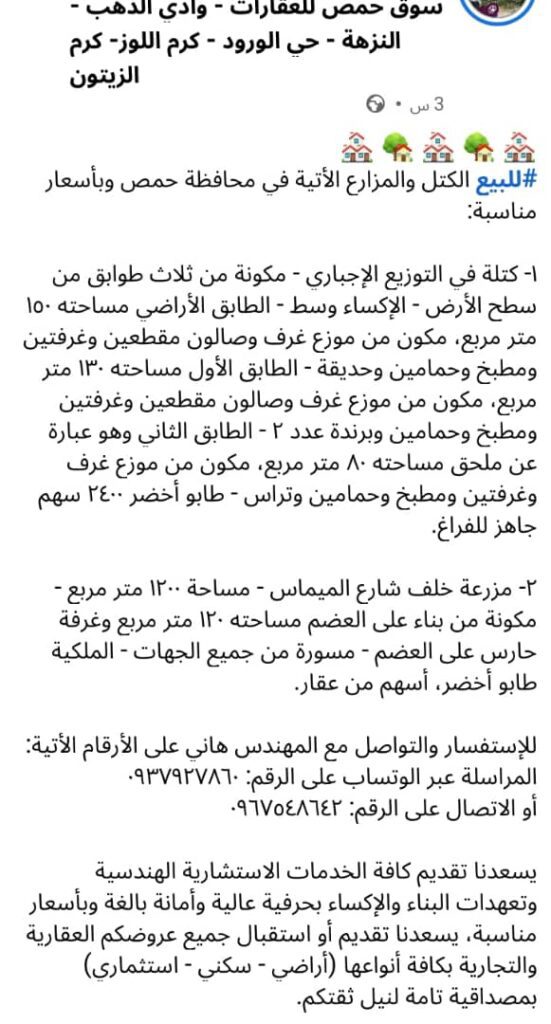
[Real estate listings for sale]
These fleeing families are heading toward the outskirts of Tartous, specifically to areas like Duwayr al-Sheikh Saad and the village of Sheikh Saad. There, they find a semblance of security within an Alawite majority and property prices that remain accessible. It is a forced migration where the Alawites of Homs pay a staggering price for their lives, leaving behind history, memories, and homes that no longer shelter them in a city where extremists and certain local factions sow chaos, terror, and death.
New Blood in “Bab al-Sba’a”: The Illusions of Homeland and Patriotism
Just four days ago, the soil of Homs was drenched in new blood. Two young men, Yasser Hussein Abbas and Hussein Hamdi, driven by poverty, sought work at a factory in the Sunni neighborhood of Bab al-Sba’a. There, they were betrayed. They had trusted the “other,” believing they were fellow Syrians and that the homeland was wide enough for all. But those resonant slogans of “patriotism” and “national unity” proved to be illusions, shattered by the bullets of treachery. It was a brutal reminder that the wounds of division run deeper than many dare to admit.


[Photos of the youths Hamdi and Abbas]
The Iran-Israel War: A Noose Tightening Around Alawite Necks
As the Iran-Israel war escalates, the pressure on the Alawite community intensifies. A significant number of them, who worked in South Lebanon and the Southern Suburbs (Dahiya) of Beirut, have been forced to flee. Some attempted to return to Syria, only to be met by the police and border guards of Hay’at Tahrir al-Sham (HTS). They were subjected to brutal beatings; some were imprisoned, others robbed, and some lost their lives. These chapters of agony repeat daily, writing an endless tragedy.
Economic Cruelty: From Firewood to Summer Crops
The economic strangulation is no less merciless than the security threats. Alawites struggling to survive by selling firewood face daily harassment; military checkpoints sometimes allow their goods through, only to confiscate them the next time, or even arrest the sellers themselves. Those working in charcoal production live in constant fear of raids where their hard-earned labor is seized, leaving them cast into the unknown.
Even the smallest Alawite-owned shops have not escaped the “Supply Patrols” (Tamween). A friend from an Alawite village notes: “The patrols are in the village every day. The smallest fine they levy on a mid-sized shop is a hundred dollars—an amount that often repeats multiple times a month.” This is a policy of systematic impoverishment and displacement, driving small traders into bankruptcy amidst a suffocating recession. Most operate on debt—buying and selling on credit—in an endless cycle of “deferred death.”
In the Al-Ghab Plain, farmers face an existential challenge. They have yet to plant their summer crops, such as okra and peanuts. Anxiety is high that the authorities may block irrigation water from the Asharnah Dam this year. This mirrors the catastrophe of the previous year, which was exceptionally disastrous—a dry year that consumed everything in its path. Only a few have dared to plant onions and spring vegetables in a desperate attempt to cling to the land.
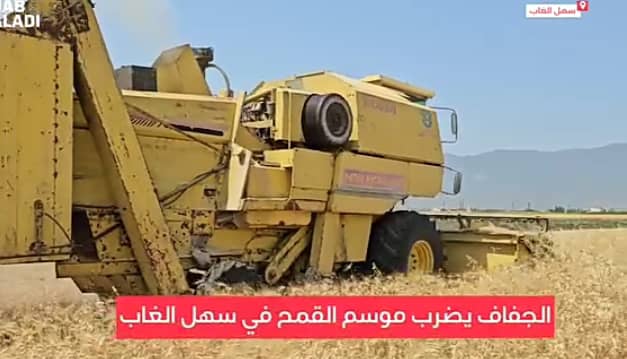
[A harvester in the parched fields of Al-Ghab]
In the coastal plains of Akkar and Baniyas, the greenhouses—once a symbol of self-sufficiency—have become fragile monuments to a dying dream. A systematic war of impoverishment is being waged against the local farmer. By favoring imports over the sweat of the tiller, the authorities have effectively strangled the local pulse, bloating the pockets of a few middlemen while hollowing out the lives of the producers. It is an orchestrated collapse.
A Fracture in the Soul: The Firewood Seller’s Tale
Amidst this structural decay, the story of my friend emerges—a young man from the mountains who took to selling firewood to survive. Day after day, he pushed his ancient motorcycle up rugged slopes, burdened with loads that defied gravity and the machine’s endurance. One evening, under the weight of his own survival, the bike gave way. He fell, and both his legs were shattered.
This man, an army veteran who spent his youth repairing complex military machinery, found himself unable to repair his own body. At the Jableh State Hospital, the verdict was as cold as the operating table: surgery required expensive orthopedic plates and screws—luxury items for the destitute. With no money and no state support, the doctor offered the only “remedy” left for the poor: absolute, motionless bed rest for two months.
And so, he lay still. Through the unwavering devotion of his wife and the meager, gathered contributions of his kin and neighbors, he endured the silence of the sickbed. Today, he takes his first tentative steps on crutches—a living testament to a resilience carved out of pure pain.
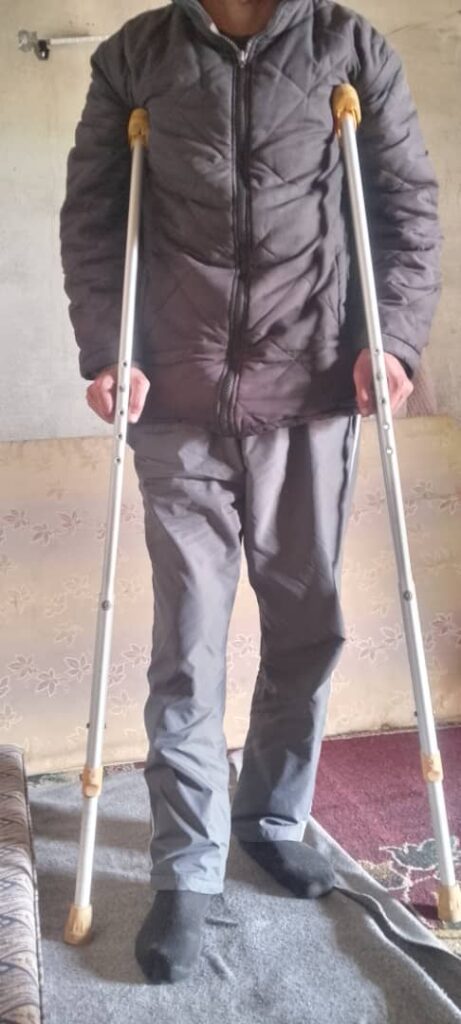
[A photo of the friend on crutches, or a symbol of endurance.]
This is not a fable; it is the raw, unvarnished reality of the Syrian coast today. What we are witnessing—the silent displacement of a people from their dignity and their land—demands a new literary genre. Let us call it the “Literature of the Aftermath” or “Letters from the Post-Massacre Era.” It is a genre that must document the agony of a community being quietly erased from its own history, left with nothing but the echoes of their crutches on the pavement.